Home >Online Product Documentation >Table of Contents >More About the Navigation Bar
More About the Navigation Bar
As you add components to your report, Stylus Studio adds glyphs that represent them to the canvas navigation bar. You can click these glyphs to place the editor's focus on a specific component; similarly, when you select a component from the canvas, the glyphs in the navigation bar change to reflect the editor's current focus.
Consider the following report - it contains two tables, each with a number of columns, and some text headings.
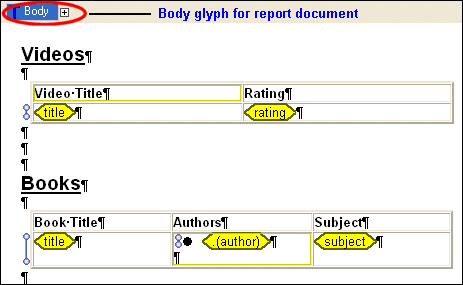
The Body glyph in the navigation bar represents the report's body. The dark blue means that the report body - the table headings and empty paragraph markers - has the editor's focus. In other words, any editing performed now - changing the text to italic, or making the background a different color, for example - would affect every object in the report body.
The plus sign next to the Body glyph indicates that the report body has at least one child. Our report has two children - the table containing video data, and the table containing book data. If we click the plus sign, Stylus Studio displays a drop-down menu that lists the children of the report body, and we see the entries for the video and book tables.
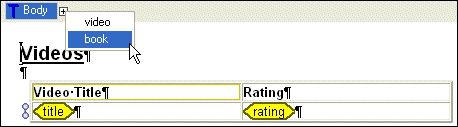
Click the Glyph to Navigate
You can use the glyphs in the navigation bar to quickly change the editor's focus to the component you select. If we select book from the Body glyph drop-down menu, for example:
- The editor's focus moves to the
booktable. Notice the dashed line around the table in Figure 493. - The navigation bar changes to reflect the editor's focus.
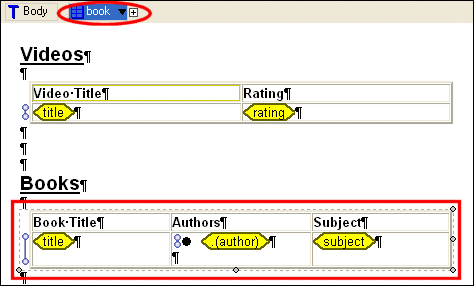
Notice that the book glyph, which represents the table containing book data, has two symbols to its right:
If we now click a cell directly, say, the cell containing author data, notice how the navigation bar changes:
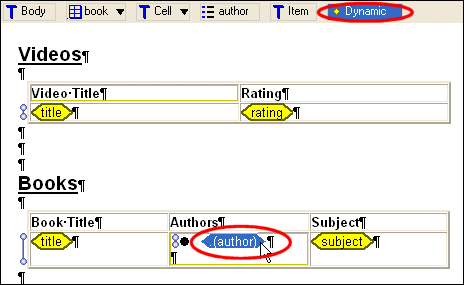
In this fashion, the navigation bar operates a tree, always showing you the report component that currently has focus. Components are displayed from the most general to the most specific. Look at the navigation bar in Figure 494. When the author glyph in the table is selected, the glyphs in the navigation bar are interpreted this way (from left to right):
Navigation Bar Glyph
|
Represents
|
|---|---|
 |
The entire report. Every other component is a child of the body component.
|
 |
The book table. The down arrow means that the table has siblings.
|
 |
The cells in the book table. The down arrow means that the cell has siblings - the other cells in the table.
|
 |
The list component built on the author element.
|
 |
An item in the list component.
|
 |
The dynamic value of the author element. It is dark blue because in our example (Figure 494), it is the report component that currently has focus.
|
Notice the video table is not represented in the navigation bar. This is because the current context in the report canvas is owned by the book table. You can quickly change context in the canvas by either