Using <%=ConfigurationManager.AppSettings["SS"]%> with RenderX XEP
RenderX XEP is a production-quality engine that converts XSL:FO into PDF or PostScript files, for use in single-source publishing, multi-channel publishing, and XML content management applications. XSL:FO is an intermediate publishing format. In order to actually use it for something, a program such as RenderX XEP (called a renderer) is necessary. The most common target for rendering is the PDF format.
Starting with Stylus Studio 2006 Release 3, DataDirect Technologies and RenderX, Inc. have worked together to package RenderX XEP with <%=ConfigurationManager.AppSettings["SS"]%>.
Configuring <%=ConfigurationManager.AppSettings["SS"]%> for RenderX XEP Use
To switch to using PDF output, we'll need to get to the Scenarios dialog for the XSLT or XQuery program we're working on. Then go to the "Post-process" tab.
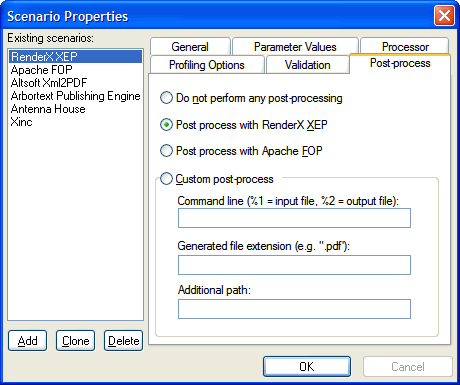
Switch your processing from "Do not perform..." to "Post process with RenderX XEP", and you are all set. (Note that although you can install any XSL:FO to PDF renderer, only RenderX XEP and Apache FOP are included with <%=ConfigurationManager.AppSettings["SS"]%>.)
Now, we are ready to begin actually using <%=ConfigurationManager.AppSettings["SS"]%> and RenderX XEP together.
Generating and Rendering the XSL:FO File
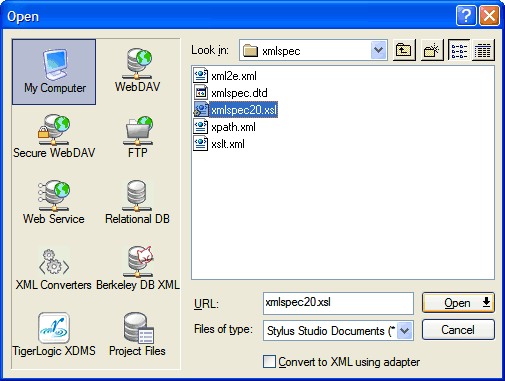
Choose your XSL:FO file. RenderX has kindly provided some samples that you can download from here. We'll use the "XPath Recommendation" one. You can download the transforming .xsl and other source files from here.
File|Open and navigate to the directory in which you unzipped them, and you should see something like:
Then choose the Scenario Properties dialog, either from the XSLT or XQuery menu or
from the  button and set the Source XML URL.
For the XPath 1.0 specification, choose the
button and set the Source XML URL.
For the XPath 1.0 specification, choose the xpath.xml file that was in the
same directory as the .xsl file above. (In your copy, it might be called REC-xpath-19991116.xml)
Next, choose the Post-process tab. There, select "Post process with RenderX XEP". That's all it takes to configure XEP to work with <%=ConfigurationManager.AppSettings["SS"]%>.
Now choose XSLT|Preview Result (or XQUery|Preview Result) or click on the  icon, and the preview
window will show the PDF as generated by <%=ConfigurationManager.AppSettings["SS"]%> working in harmony with XEP.
icon, and the preview
window will show the PDF as generated by <%=ConfigurationManager.AppSettings["SS"]%> working in harmony with XEP.
Whether you are interested in XSL:FO, RenderX, or <%=ConfigurationManager.AppSettings["SS"]%>, we've got the goods. Try it yourself by heading over to here to download a copy of <%=ConfigurationManager.AppSettings["SS"]%> with RenderX XEP, and explore both the XML Editor and the XML Publishing module for designing beautiful XML reports.