Home >Online Product Documentation >Table of Contents >Images
Images
An image is a component that contains a GIF, JPEG, or some other graphic file. You can place image components within other components (like tables, lists, and repeaters, for example), or directly on the report body.
Creating an Image
To create an image component:
Alternative: Right-click and select Insert image from the short-cut menu.
Graphical Representation
In the XML Publisher canvas, an image is represented as a small square with a cross-hatched pattern. Figure 501 shows an image component that includes some text to its right - (photo of the author).

Images are resolved when you preview the report only if the image files are accessible to Stylus Studio using the source information you have specified. Unresolved images are rendered as red Xs, as shown in Figure 502:

Specifying an Image Source
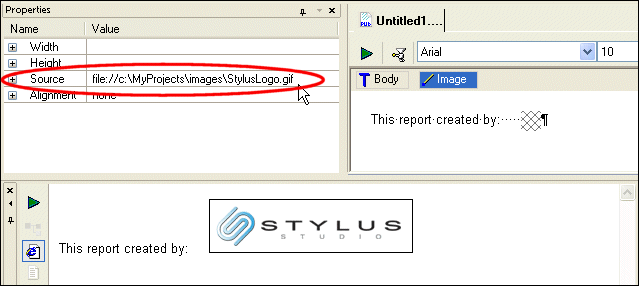
You can use static and dynamic images in a report. A static image is one that never changes. An example of a static image is a corporate logo that appears in a fixed place on a report. To specify a static image, just the complete file URL in the image's Source property - file://c:\MyProjects\StylusLogo.gif, as shown in Figure 503.
A dynamic image is one whose source changes based on the context defined for it. An example of a dynamic image is the cover art for the movies in the videos.xml document - the image varies based on the video id as determined by the current context.
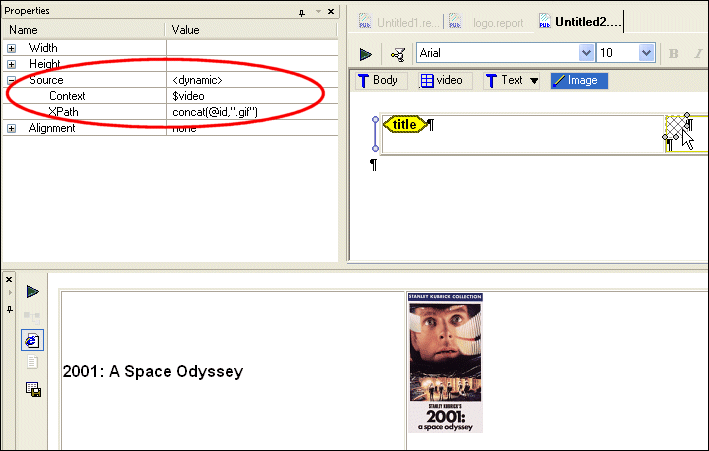
To specify a dynamic image, you need to define the image component's Source property's Context and XPath sub-properties:
- Context - defines the document context for the evaluation of the Source property's XPath sub-property. This can be a source document URL, or a variable.
- XPath - an XPath expression used to evaluate the source document; the context for the XPath expression is determined by the Context sub-property. This can be any XPath expression.
When you specify these properties, Stylus Studio displays <dynamic> in the Source property field.
Note
|
| Regardless of whether you are using static or dynamic images, the image source must be available to the finished HTML+CSS or XSL-FO report. |
Example: Specifying a Dynamic Image Source
The cover art for the movies in the videos.xml document are written to the \examples\VideoCenter\images\video\ directory where you installed Stylus Studio. The name of each .gif file is the same as the value of the id attribute of the video repeating element. We want to create a simple table displaying the movie's title and its cover art, as shown in Figure 504.
To create this report in XML Publisher, we would:
video repeating element and dropping it on the canvas. This establishes the context for the cells in the table, as well as creating a value, $video, that represent this context.
title element in the table's first cell (as a value).
$video. The context for this variable (result/videos/video) was established automatically when we used the video repeating element to create the table.
concat(@id)".gif". This concatenates the value of the current id attribute with the string .gif to identify image file to display. The source for these image files is specified in the following step.
c:\Program Files\Stylyus Studio\examples\VideoCenter\images
\video\
, or wherever you have installed Stylus Studio.
Specifying Image Size
By default, Stylus Studio displays the image in the finished report using the source file's dimensions. You can use the image component's Width and Height properties to specify a different size. When you do this, Stylus Studio changes the dimensions of the image glyph (see Figure 501) on the canvas to reflect the change.